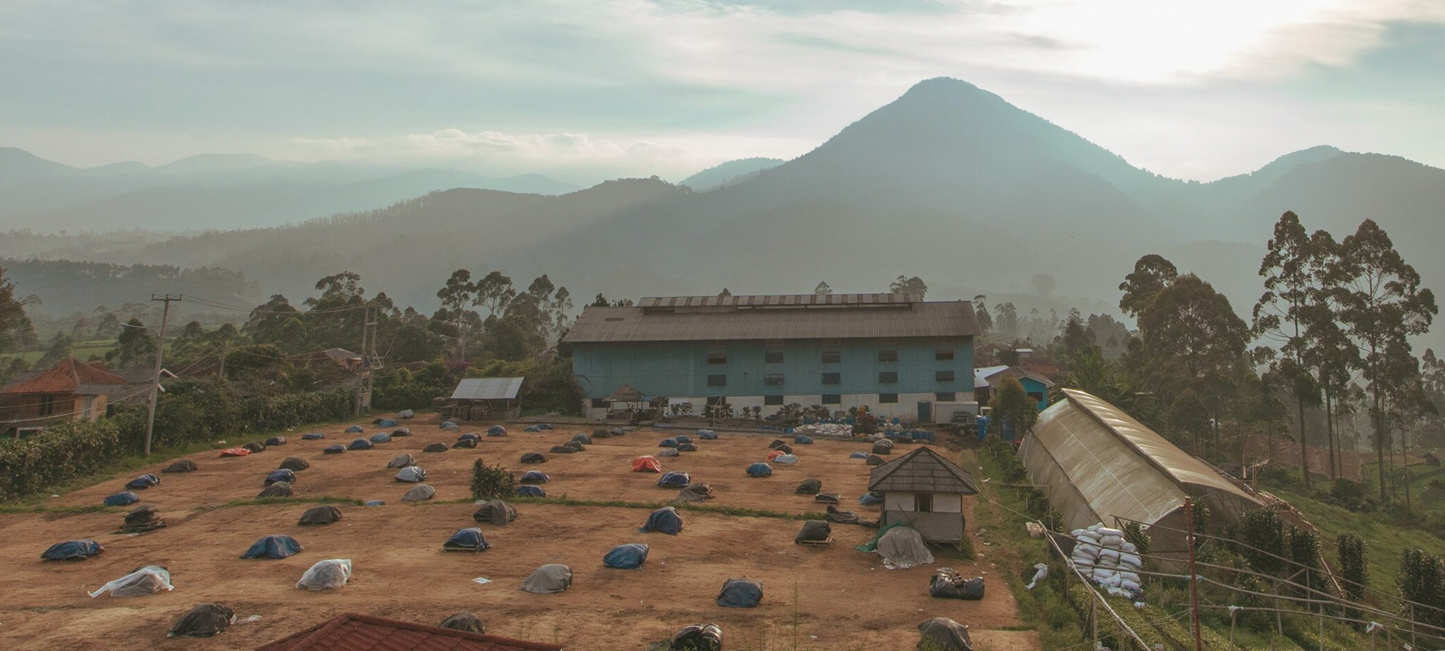
Frinsa
Producer: Fikri Raihan Hakim - Frinsa Estate
Origin: Pangalengan, Garut, West Java, Indonesia
Elevation: 1350-1700 MASL
Variety: Field Blend
Process: Wet Hulled
Roast Level: Light-Medium
Importer: Across Indonesian Seas
Flavor Notes: Orange, Graham Cracker, Pu-erh Tea
We have another impressive lot from the Frinsa Estate here, this time highlighting one of the hallmark processing methods of Indonesia that doesn't see much love from the specialty coffee world. This Frinsa lot is processed via wet hulling which is a processing method born out of microclimate. Indonesia has an average relative humidity for 70-90% year round, this makes drying coffee quickly and evenly a challenging task especially where infrastructure and small holder producers often can't support mechanical dryers and such, and thus, wet hulling is born (more on this later). Massive thanks to Owen of Across Indonesian Seas for reaching out connecting Enjoy to what is easily the most uniform, and impressive, wet hulled coffee we've ever come across.
Indonesian coffees are a bit of a rare bird in the specialty circles these days, but with the right approach and detailed process, there are complexities and cup profiles that we find in Indonesia that are completely unique to their own.
As told by Across Indonesian Seas: Although Indonesia is one of the oldest coffee-producing countries, producers there are in the middle of developing its own specialty coffee industry within the country, which is different from the development of the specialty coffee industry in Africa and Latin America. The low elevation of the land and the traditional processing methods of Sumatran style are not exactly the best environment to produce clean cup coffee with fruity acidity that is the standard of specialty coffee. Having said that, Indonesian coffees have a certain remarkable charm. They are earthy, herbal, rich, and sweet.
Java Frinsa Estate is operated by Fikri Raihan Hakim who is 25 years old and is the second generation owner of the company. Fikri states, My grandfather was a farmer growing potatoes and other crops. He sold them to supermarkets. My father started a coffee business in 2010 when I was a high school student. The name ‘Frinsa’ comes from the first letters of the name of my siblings: F for Fikri, R for Rifda, N for Nadia, and S for Salsa. The four coffee cherries and coffee leaves are the design of our logo. My parents wanted to nurture this business like they have nurtured their children.
When it comes to Frinsa's processing methods, Fikri states The most important point is how to better create a farm. We grow coffees in the forest while leaving the surrounding plants and trees in their original state as much as possible. We use organic fertilizers and clean water to maintain the health of the coffee trees. We only use the minimum amount of pesticides when it is absolutely necessary.
The second point is the processing method. We use four main processing methods: washed process, wet-hulled process also known as Sumatra-style process, honey process, and natural process, and we are particular about the fermentation of each processing. For washed process and natural process, we add lactic acid bacteria (lactobacillus) during the fermentation process. For honey process, we have lots that have added lactobacillus but also lots fermented by adding ‘tempeh bacteria’ which is a bacteria from tempeh, a traditional Indonesian fermented soybean food, and ‘saccharic acid’ an ingredient found in a fermented tea such as kombucha. These are the new approaches.
The last point is varieties of coffee. Our farm produces only a single variety while our partner farms produce both single variety and mixed varieties. Most of the varieties we grow are indigenous to Indonesia and we grow seven varieties: P88, Borbor, Lini S, Andung Sari, TimTim, Ateng Super, and Sigarar Utang. We try to harvest only one variety per day to avoid the risk of mixing varieties.
Most of the specialty coffees we produce score above 85 points and we value the uniqueness of our coffee in Indonesia. We have been able to win several awards overseas because we were praised for its uniqueness.
So, back to wet hulling. As we said, this process was born out of a need to dry coffee faster. Why? Because if coffee drys too slowly bad things can happen - bad things like mold development, over fermentation, pests, etc. So, the wet hulled process takes coffee from cherry to raw green seed in one felt swoop in order to give the seed the best chance to dry more quickly with the high average humidity. But, stripping the seed down to green before it has had a chance to dry and harden leaves it venerable to a range of risks as well. All this said, it takes a ton of work, care, and expertise to yield a coffee like we have here.
In the cup you can expect a bigger bodied coffee with a graham cracker like sweetness and orange-y acidity. There is a through-line of puh-erh tea and sweet tobacco-like qualities that add a ton of depth and complexity to the cup profile.
This is a gem for sure. Snag a bag of our second Indonesian coffee of the year!
Couldn't load pickup availability
Shipping Information
Shipping Information
Shipping Days: We ship orders twice a week, on Tuesdays and Thursdays.
Shipping Method: All orders are shipped via USPS Priority Mail for prompt and reliable delivery.
Processing Time: Orders placed by 12:00 PM on Monday and Wednesday will be processed and shipped the following shipping day. Orders placed after this cutoff will be processed on the next available shipping day.
Tracking: Once your order has been shipped, you will receive a confirmation email with tracking information so you can follow its progress.